
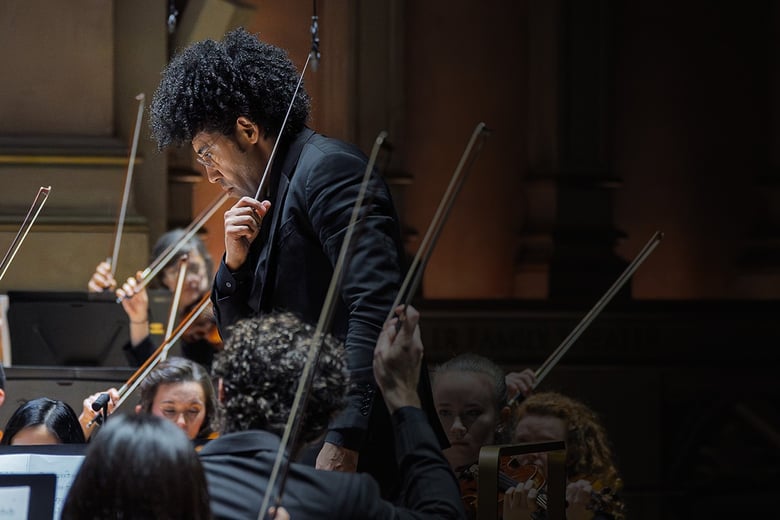
Program | Payare Leads Strauss’ A Hero’s Life
SATURDAY, OCT. 3 | 7:30PM
SUNDAY, OCT. 4 | 2PM
Jacobs Music Center
2026-27 JACOBS MASTERWORKS
PAYARE LEADS STRAUSS’ A HERO’S LIFE
Rafael Payare, conductor
Yefim Bronfman, piano
San Diego Symphony Orchestra
Steinway & Sons is the official piano of the San Diego Symphony
PROGRAM
SOFIA GUBAIDULINA
Fairytale Poem
WOLFGANG AMADEUS MOZART
Piano Concerto No. 24 in C Minor, K. 491
Allegro
Larghetto
Allegretto
Yefim Bronfman, piano
— INTERMISSION —
RICHARD STRAUSS
A Hero’s Life (Ein Heldenleben), Op. 40
The Hero
The Hero’s Adversaries
The Hero’s Companion
The Hero’s Battlefield
The Hero’s Works of Peace
The Hero’s Retirement from the World and Fulfillment
Total Program Duration:
1 hour 45 minutes
Includes one 20-minute intermission
ABOUT THE ARTISTS
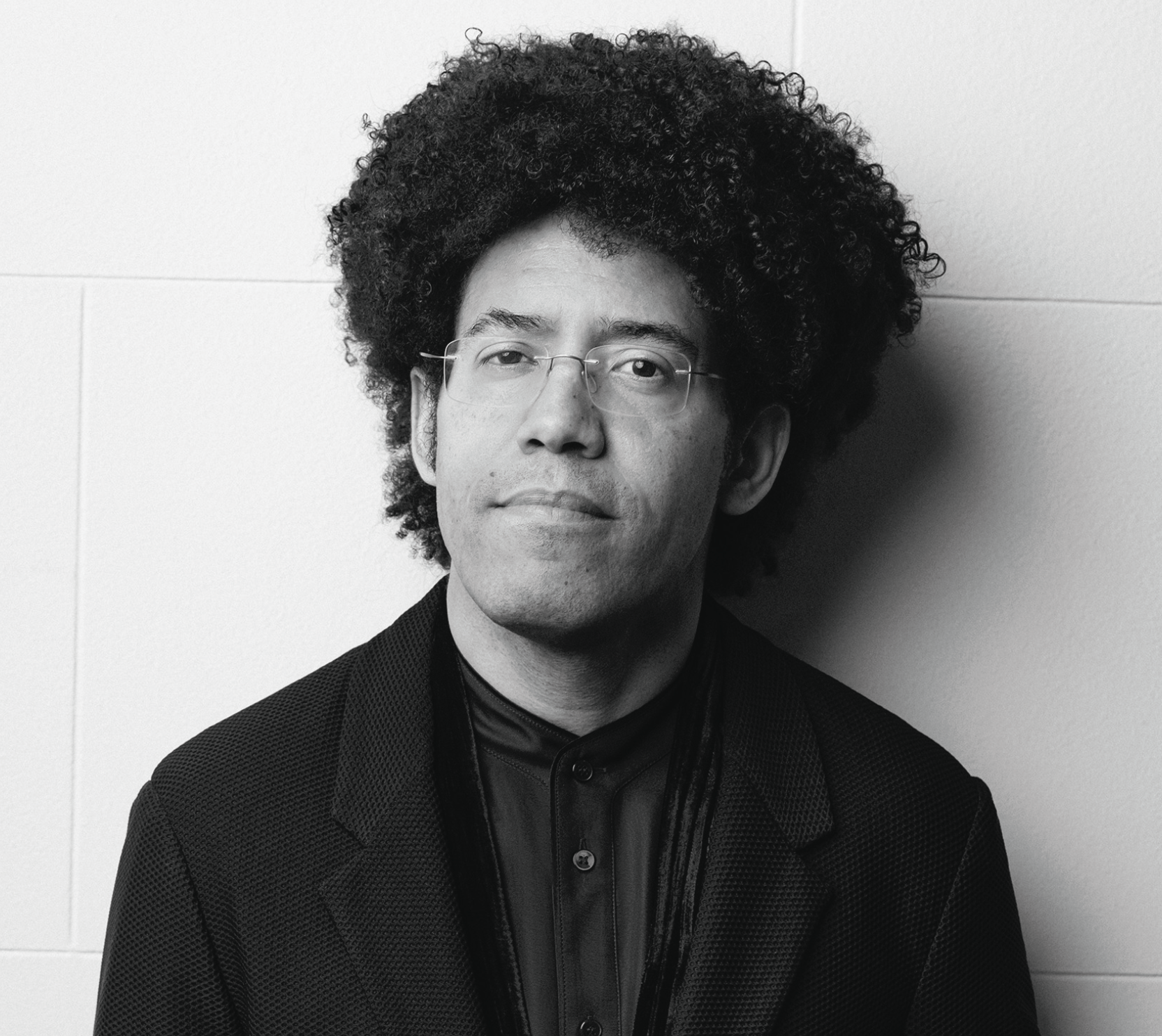
RAFAEL PAYARE
MUSIC & ARTISTIC DIRECTOR
With his charismatic energy, innate musicianship, and technical brilliance on the podium, Rafael Payare is always “electrifying in front of an orchestra” (Los Angeles Times). Since September 2019, he has been Music and Artistic Director of California’s San Diego Symphony Orchestra, where he is widely credited with inspiring “the San Diego Symphony’s splendid new sound” (Wall Street Journal).
Payare has helped usher in a bright new era for the San Diego Symphony. He and the orchestra drew international notice with the openings of The Rady Shell at Jacobs Park, their bayside open-air venue, and Jacobs Music Center, their newly renovated indoor home, where the Symphony “finally has a San Diego venue that permits it to sound like the world-class orchestra they’ve been since Payare took over” (San Diego Union-Tribune). In recent seasons, the Orchestra has presented festival programming including two weeks dedicated to Brahms, “Upright and Grand: A Tribute to the Piano,” and “It’s About Time,” a focus on percussion that included performances on both sides of the U.S.-Mexico border. Works by Brahms, Mahler, Bruckner, and Shostakovich are featured every season with Payare. The Orchestra regularly programs new music by composers including Matthias Pintscher and Gabriela Ortiz, and recently commissioned Symphony No. 6: Monarch by San Diego Symphony composer-in-residence Jimmy López. In 2023, Payare joined Gustavo Dudamel and Esa-Pekka Salonen to launch the first California Festival, a statewide celebration of contemporary music featuring the Los Angeles Philharmonic, San Francisco Symphony, and San Diego Symphony. On a 2026 Delos release, Payare conducts the San Diego Symphony Orchestra in Shostakovich’s epic seventh symphony, “Leningrad,” following the success of their digital recording of the same composer’s Symphony No. 11. He also leads the Orchestra on its first European tour in 2027, with performances in Barcelona, Dublin, Hamburg, Paris, and Toulouse. Another of his key initiatives includes the San Diego Symphony Conducting Fellowship Program, conceived to cultivate the next generation of orchestral leaders.
Beyond San Diego, Payare is Music and Artistic Director of Canada’s Orchestre symphonique de Montréal—with which he has made four Pentatone recordings and numerous appearances on Medici.tv—and Conductor Laureate of Northern Ireland’s Ulster Orchestra, where he previously served as Principal Conductor and Music Director, making multiple appearances at London’s BBC Proms. Since winning first prize at Denmark’s 2012 Malko Competition for Young Conductors, he has forged relationships with many of the world’s leading orchestras, including the Boston, Chicago, and Pittsburgh Symphonies; the Cleveland and Philadelphia Orchestras; and the Los Angeles and New York Philharmonics; the Leipzig Gewandhaus Orchestra, London Symphony Orchestra, NDR Elbphilharmonie Orchestra, Royal Concertgebouw Orchestra, Staatskapelle Berlin, Tonhalle Orchestra Zurich, and Vienna Philharmonic. He has also led productions at London’s Royal Opera House, the Glyndebourne Festival, Stockholm’s Royal Swedish Opera, and the Royal Danish Opera.
An alumnus of Venezuela’s El Sistema program, Payare founded Montreal’s El Sistema OSM. He has led youth projects with the Chicago Civic Orchestra, Orchestra of the Americas, Filarmónica Joven de Colombia, and London’s Royal College of Music, and has conducted the National Youth Orchestra of Ireland on tour and lead NYO2 at Carnegie Hall and the Edinburgh Festival.
Payare lives in San Diego and Montreal with his wife, cellist Alisa Weilerstein, and their two children.
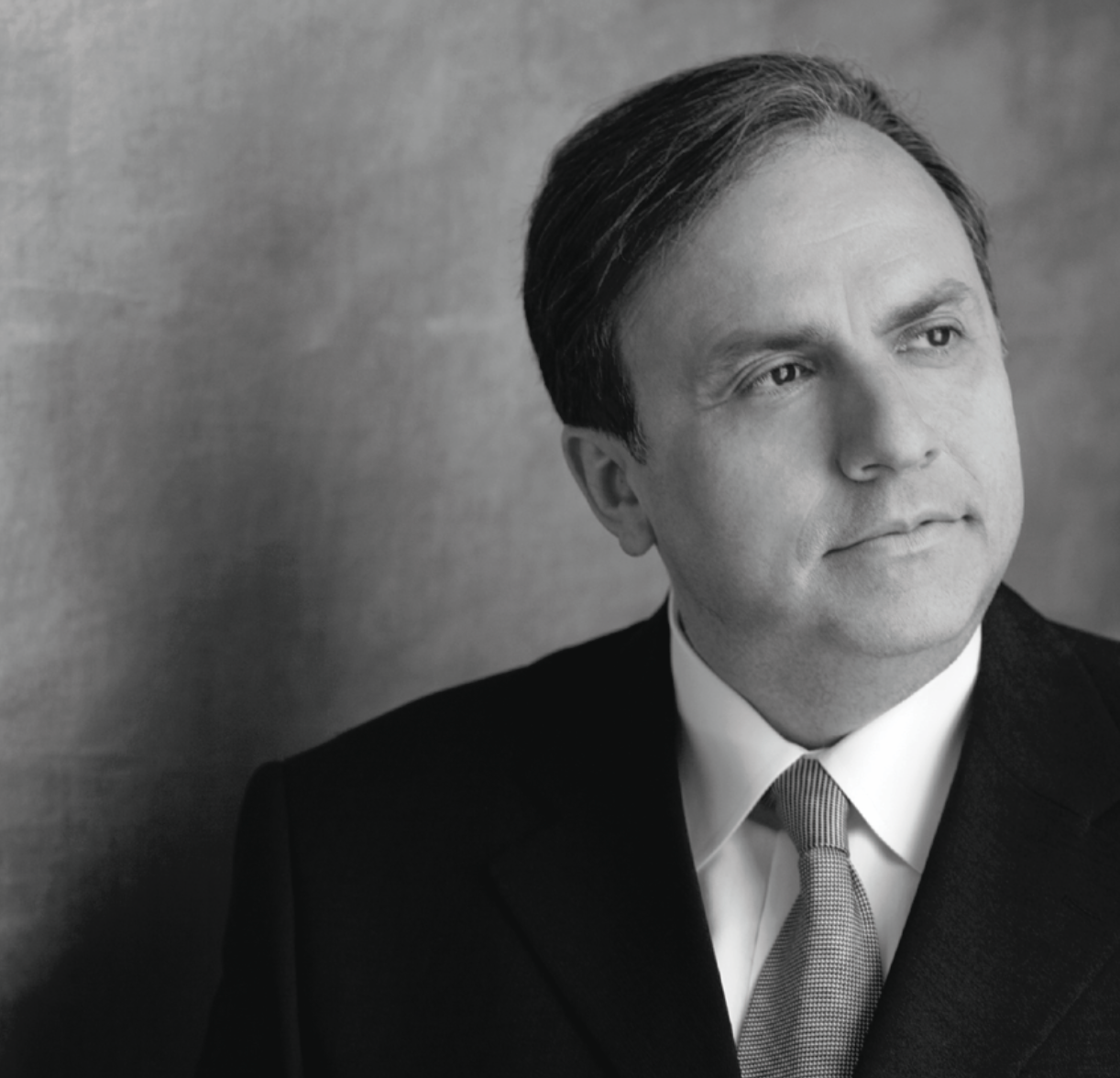
YEFIM BRONFMAN
PIANO
Internationally recognized as one of today’s most acclaimed and admired pianists, Yefim Bronfman stands among a handful of artists regularly sought by festivals, orchestras, conductors and recital series. His commanding technique, power and exceptional lyrical gifts are consistently acknowledged by the press and audiences alike.
Following return visits to summer festivals in Vail and Tanglewood, the season begins with the St. Louis Symphony Orchestra and concludes with the closing week of the San Francisco Symphony. With orchestras in North America, he returns to Chicago, Los Angeles, New York, Philadelphia, Houston, Pittsburgh, Washington DC, Nashville, San Diego, Buffalo, Ft. Wayne, and Kalamazoo. In addition to a return to the Israel Philharmonic, he can be heard in Europe with orchestras in Berlin, Munich, Paris, Geneva, Milan, Turin, Athens, and Lyon.
Mr. Bronfman works regularly with an illustrious group of conductors, including Daniel Barenboim, Herbert Blomstedt, Semyon Bychkov, Riccardo Chailly, Christoph von Dohnányi, Gustavo Dudamel, Charles Dutoit, Daniele Gatti, Valery Gergiev, Alan Gilbert, Vladimir Jurowski, Zubin Mehta, Riccardo Muti, Andris Nelsons, Yannick Nézet-Séguin, Sir Simon Rattle, Esa-Pekka Salonen, Jaap Van Zweden, Franz Welser-Möst, and David Zinman. Summer engagements have regularly taken him to the major festivals of Europe and the US. Always keen to explore chamber music repertoire, his partners have included Pinchas Zukerman, Martha Argerich, Magdalena Kožená, Anne-Sophie Mutter, Emmanuel Pahud and many others. In 1991 he gave a series of joint recitals with Isaac Stern in Russia, marking Mr. Bronfman’s first public performances there since his emigration to Israel at age 15.
Widely praised for his solo, chamber and orchestral recordings, Mr. Bronfman has been nominated for six Grammy® Awards, winning in 1997 with Esa-Pekka Salonen and the Los Angeles Philharmonic for their recording of the three Bartok Piano Concerti. His prolific catalog of recordings includes works for two pianos by Rachmaninoff and Brahms with Emanuel Ax, the complete Prokofiev concerti with the Israel Philharmonic and Zubin Mehta, a Schubert/Mozart disc with the Zukerman Chamber Players and the soundtrack to Disney’s Fantasia 2000. His most recent CD releases are the 2014 Grammy® nominated Magnus Lindberg’s Piano Concerto No. 2 commissioned for him and performed by the New York Philharmonic conducted by Alan Gilbert on the Da Capo label; Tchaikovsky’s Piano Concerto No.1 with Mariss Jansons and the Bayerischer Rundfunk; a recital disc, Perspectives, complementing Mr. Bronfman’s designation as a Carnegie Hall ‘Perspectives’ artist for the 2007-08 season; and recordings of all the Beethoven piano concerti as well as the Triple Concerto together with violinist Gil Shaham, cellist Truls Mørk, and the Tönhalle Orchestra Zürich under David Zinman for the Arte Nova/BMG label.
Now available on DVD are his performances of Liszt’s second piano concerto with Franz Welser-Möst and the Vienna Philharmonic from Schoenbrunn, 2010 on Deutsche Grammophon; Beethoven’s fifth piano concerto with Andris Nelsons and the Royal Concertgebouw Orchestra from the 2011 Lucerne Festival; Rachmaninoff’s third concerto with the Berlin Philharmonic and Sir Simon Rattle on the EuroArts label and both Brahms Concerti with Franz Welser-Möst and The Cleveland Orchestra (2015).
Born in Tashkent in the Soviet Union, Yefim Bronfman immigrated to Israel with his family in 1973, where he studied with pianist Arie Vardi, head of the Rubin Academy of Music at Tel Aviv University. In the United States, he studied at The Juilliard School, Marlboro School of Music, and the Curtis Institute of Music, under Rudolf Firkusny, Leon Fleisher, and Rudolf Serkin. A recipient of the prestigious Avery Fisher Prize, one of the highest honors given to American instrumentalists, in 2010 he was further honored as the recipient of the Jean Gimbel Lane prize in piano performance from Northwestern University and in 2015 with an honorary doctorate from the Manhattan School of Music.
ABOUT THE MUSIC
Fairytale Poem (Poema-Skazka)
SOFIA GUBAIDULINA
Born October 24, 1931, Christopol, Tatar Republic
Died March 13, 2025, Appen, Germany
APPROXIMATE PERFORMANCE TIME
12 MINUTES
Sofia Gubaidulina graduated from the Kazan Conservatory in 1954 and went on to the Moscow Conservatory, where she studied piano and composition. Drawn to both experimental music and to the spiritual dimension of music, Gubaidulina established herself as one of the leading members of the avant-garde in the Soviet Union at a time when that was a difficult identity. In 1971 she was asked to provide background music for a children’s radio play titled The Little Chalk, based on a Czech fairy tale. Her music was performed as part of that production, but since then it has been performed as a purely orchestral work. The original fairy tale told a charming story, but Gubaidulina sensed a larger meaning behind that gentle story and came to regard it as “a parable about an artist’s destiny.” Her summary of the fairy tale makes clear the connection between a piece of chalk and the role of the artist in society: “The main character is a small piece of chalk used for writing on school chalkboards. The chalk dreams that someday it will draw wonderful castles, beautiful gardens with pavilions, and the sea. But, day in, day out, it is forced to write boring words, numbers, and geometric figures on the board. The children grow with each day, but the chalk becomes smaller and smaller. The chalk gradually becomes despondent and loses all hope of ever having a chance to draw the sun and the sea. Soon it will be so small that it will no longer be used in the school classroom and will end up being thrown away. Then the chalk once again finds itself in total darkness and thinks that it has died. What it thought was the darkness of death is actually the inside of a boy’s trousers pocket. The boy pulls the chalk out of his pocket and in the light of day begins to design castles, gardens with pavilions, and the sea with the sun on the asphalt. The chalk is so happy that it does not notice how it meets its end while drawing this beautiful world.”
Piano Concerto No. 24 in C Minor, K. 491
WOLFGANG AMADEUS MOZART
Born January 27, 1756, Salzburg
Died December 5, 1791, Vienna
APPROXIMATE PERFORMANCE TIME
31 MINUTES
In the spring of 1786 Mozart was hard at work on The Marriage of Figaro, but in March he paused briefly to compose two piano concertos for the Lenten concert season. They are two of his greatest works, yet they could hardly be more unlike. The Concerto No. 23 in A Major, completed on March 2, is all sunlight and gentle lyricism, but the Concerto No. 24 in C Minor, completed three weeks later on March 24, is one of Mozart’s darkest and most powerful works. The manuscript betrays unusual agitation: there are numerous passages scratched out and–remarkably for this composer–there are a number of mistakes: wrong notes, things left out, passages inserted in the wrong places. It is dangerous to attempt to make connections between the condition of a manuscript and its creator’s mental state, but everything about this concerto suggests trouble and turbulence.
C minor was the key Mozart reserved for his most emotionally charged music, and he employs the largest orchestra here he ever used in a concerto, requiring both oboes and clarinets. Everyone instinctively senses the symphonic character of this concerto: it exists not as a showcase for the pianist but as the most serious symphonic argument in which piano and orchestra participate as equals.
The orchestra’s quiet but ominous opening theme will form the backbone of the Allegro. There is no true “contrasting” second subject but instead a wealth of secondary material, some of it derived motivically from the rhythm of that fertile opening theme. Even the piano’s seemingly calm entrance can be traced to material already introduced, and it too is soon penetrated by bits of the opening theme. Mozart left no cadenza, but the ending of this movement is as remarkable as everything else in it: the orchestra’s entrance after the cadenza is not a gentle return but almost an explosion, and then–most unusually– the piano returns in the coda and helps propel the movement to a muttering close in which none of its tensions has been resolved.
Relief comes in the Larghetto, which moves to E-flat major. Solo piano introduces the singing main theme of what will be a slow rondo, but this one is ingenious: each of the three interludes is introduced by the woodwind band, and then piano and strings comment on their music.
The dark mood of the opening movement returns at the first instant of the finale: we are back in C minor, and the strings’ opening theme breathes the same air of suppressed power of the concerto’s opening. The finale is a variation-form movement, based on its opening theme. The variations are often double variations, with the second part a development of the first, and along the way Mozart offers two episodes, both introduced by the winds. At the end, Mozart pauses for a cadenza, but when the orchestra returns, he re-bars the main theme in 6/8, and on that flowing meter the concerto dances to its close. Or at least tries to, for Mozart remains firmly in C minor, and the music closes in darkness and defiance.
Mozart’s Concerto in C Minor has moved countless listeners, but none more than a young pianist named Beethoven who arrived in Vienna six years later. Listening to a performance of this concerto with his friend the pianist Jean-Baptiste Cramer, the young Beethoven nearly despaired, exclaiming: “Oh, Cramer! Cramer! We will never be able to do anything like this!” Yet the influence of this concerto can be felt in much of Beethoven’s music: in the choice of key, in the dark and dramatic argument, and even in the shape of themes–the opening of Beethoven’s Third Piano Concerto, composed in 1800, is clearly “lifted” from the opening of this concerto. It is as if the extraordinary power of Mozart’s music, still trembling in the air of Vienna, took hold of the young composer in a way he could not escape.
A Hero’s Life (Ein Heldenleben), Op. 40
RICHARD STRAUSS
Born June 11, 1864, Munich
Died September 8, 1949, Garmisch-Partenkirchen
APPROXIMATE PERFORMANCE TIME
44 MINUTES
In the summer of 1898 Richard Strauss set to work on what would be his longest tone poem to date, Ein Heldenleben, or A Hero’s Life–the musical depiction of the life and struggles of an unnamed hero. In a letter to a friend that summer, Strauss offered a rather disingenuous explanation of why he had chosen this topic: “Beethoven’s ‘Eroica’ is so little beloved of our conductors, and is on this account now only rarely performed that to fulfill a pressing need I am composing a largeish tone poem entitled Heldenleben, admittedly without a funeral march, but yet in E-flat, with lots of horns, which are always a yardstick of heroism.”
But the work that was completed that December and premiered the following March was far indeed from the spirit of the Eroica, and Strauss was probably right to note that the only thing the two pieces have in common is the same key, E-flat major. Even if it was originally intended as a tribute to Napoleon, the Eroica remains an abstract representation of heroism, but Strauss sets out to tell the story of his hero in microscopic detail. In Ein Heldenleben he paints detailed portraits of his hero, the hero’s snarling adversaries, a coquettish lover, a terrific battle in which his enemies are chased off the field, and the hero’s reward of a contemplative if not entirely serene retirement.
Ein Heldenleben has one of the greatest openings in all of music. From the depths of the orchestra, Strauss introduces his hero with a long, sweeping theme whose powerful stride leaps up across three octaves, changing from the dark colors of lower strings and horns to the silvery sound of massed violins as it climbs. Here is a man of force and idealism, and the arc of his music is always upward–Strauss’ hero constantly strives toward something higher, and the hero’s music is riding a shaft of incandescent energy when it suddenly vanishes in mid-air.
Out of that silence come the hero’s enemies, and if the hero’s music is always arcing higher, the music of his foes is twisted and gnarled, depicted by ugly, carping solo woodwinds, each of whom seems to have a particularly nasty character. The hero’s theme grows somber as he muses on these adversaries, but before he can face them he is interrupted by the other important figure in this music-drama, his lover. Strauss confessed that she was modeled on his own wife: “She is very complex, very feminine, a little perverse, a little coquettish, never like herself, at every minute different from how she had been the moment before.” Here she is portrayed by the solo violin, and as he paints her mercurial portrait, Strauss gives the concertmaster passages marked “happy,” “flippant,” “tender,” “insolent,” “lovable,” and “scolding” (among others) before the union is consummated in soaring G-flat major love music that intertwines the themes of the hero and his love.
Their happiness is brief. Distant trumpets pierce the warm calm of the love scene, calling the hero to battle. Over rattling drums, his enemies attack, their jagged trumpet call a wonderful transformation of the first theme from the adversaries’ section. Finally the hero triumphs and chases his enemies away, and he makes a magnificent entrance on the hero’s theme, now back in the original E-flat major.
There follows the most controversial section of Ein Heldenleben. A recounting of the hero’s “works of peace,” it takes the form of quotations from Strauss’ own music, and critics have been quick to interpret Ein Heldenleben as a vehicle for Strauss’ ego–listeners will recognize quotations from Don Juan, Don Quixote, Macbeth, Guntram, Till Eulenspiegel, and others.
If the hero’s works of peace can seem self-indulgent, Strauss rewards our patience in the final section, a portrait of the hero in old age. He clearly suffers from bad dreams (memories of his enemies pop up from time to time to disturb his reveries), but the final moments of Ein Heldenleben bring serenity and repose. The enemies have been banished, and now the themes of the hero and his love return, at this stage in their lives transformed far from their initial hard-edged appearance. Borne along by some wonderful writing for solo violin and solo horn, the hero at last finds peace. At the close, a noble chord for winds (in pure E-flat major) swells to a mighty climax, then falls away to silence as the hero completes his journey.
—Program notes by Eric Bromberger


Comments are turned off
The author has disabled comments for this post